Within 24 hours, two people told me the AI voices I’d used sounded like other AI voices they’d heard. What struck me was that I couldn’t hear the resemblance. To my ears, the voices were clearly different.
“Sounds like every other AI voice.”
In the original videos, there was background music and each piece had a different mood. The voices sounded quite distinct to me there. Then I listened to the two presets reading the same passage, side by side. This time, I heard the resemblance too. I still heard differences in pitch and timing, but the voices felt much closer than I remembered.
A voice has a sound. It also has a way of saying things. Change one, and the other can still feel familiar. Think of two presenters reading the same weather bulletin with the same carefully timed pause before the bad news. You can hear two distinct voices and still recognise the performance.
“When people hear an AI voice, sometimes they're no longer listening to the voice itself. They're listening to their accumulated prejudice against every AI voice they've heard before.”
That was my first hunch. It’s also the hardest part of the story to test. Familiarity could make people group voices together. It could also make a frequent listener better at telling them apart. Before blaming anyone’s ears, I wanted to see what actually changed in the audio.
Listen first
I used one audio persona this week and another last week. Both read the same passage. Start with “This is a synthetic voice comparison test” and listen for which voice sits higher. When they reach “pronunciation, rhythm, emotional expression”, listen for the space between words. Then compare how they land on “natural, authentic and human”. Two voices can sit at different pitches and still give a sentence a familiar cadence.
Synthetic voice · 22.80 seconds
Synthetic voice · 22.08 seconds
If your first reaction was “those sound like the same voice”, I hear it too. The presets were different, and the graph below shows where the two takes differ. See which differences stand out when you go back for a second listen.
The text both voices were given:
This is a synthetic voice comparison test designed to explore how different AI voices handle natural speech, pronunciation, rhythm, emotional expression and subtle changes in tone. Listen carefully to each voice and decide which sounds more natural, authentic and human.
What changed in the recordings
Test 1 sounds higher and slightly brighter to me. Test 2 sits lower and leaves more room between phrases. The pitch difference shows up across several stretches of speech, so the overall result is unlikely to come from a single high or low note. Together, the lower pitch and longer pauses give Test 2 a more measured delivery.
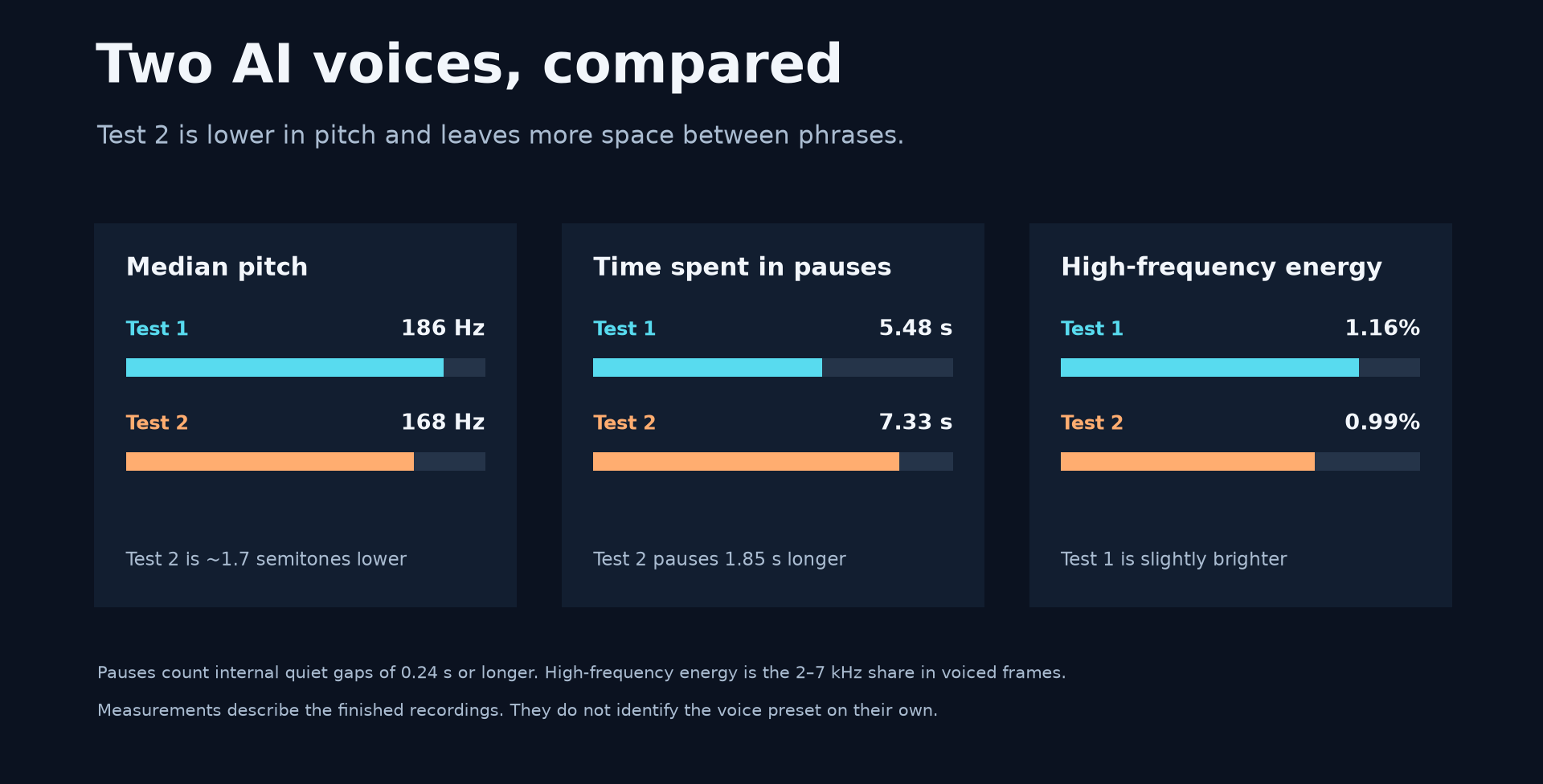
Pitch is how high or low the voice sounds. The graph summarises it using median fundamental frequency, the middle of the estimates taken while the voice was vibrating regularly. Test 1 measured 185.9 Hz and Test 2 168.4 Hz. That’s about 1.7 semitones apart. The pitch ranges still overlap, which is what you’d expect when both voices rise and fall as they speak.
Test 2 spent 7.33 seconds in internal quiet gaps, compared with 5.48 seconds for Test 1. That’s 1.85 seconds more, even though Test 2 is the shorter recording overall. The pause count tells a slightly different story. Test 2 has eight qualifying gaps and Test 1 has nine. The amount of space matters more here than how often the voice stops.
The last bars show the share of measured energy between 2 and 7 kHz in voiced frames. Test 1 had 1.16%, against 0.99% for Test 2. That small difference is consistent with my impression of a brighter sound. Microphone-like effects, mastering and encoding can also affect this measure, and it captures only one part of what we hear as timbre.
My generation settings are the basis for saying I used two presets. The measurements tell us how these particular renders differ. With one take per preset, some of that difference could come from the way each take was generated or finished. We didn’t run a listener study, so this comparison can’t tell us what cues the two people noticed.
My own change of mind comes with a caveat. The original videos and this comparison differed in more than the music. Here, both presets are reading the same script. To find out what the soundtrack contributes, I’d have to compare the exact same voice takes with and without it, at matched loudness, while keeping the wording and edit fixed.
Three questions hiding inside “same voice”
There’s the identity question. Would you pick these as the same speaker? There’s the naturalness question. Does this sound like speech someone might actually produce? Then there’s the category question. Does it remind you of AI narration?
Those questions can lead to different answers. A good impressionist can sound natural and familiar while getting the identity wrong. Two people can sound distinctly like themselves and still deliver a training module with the same relentlessly cheerful emphasis. If someone tells me it’s “the same AI voice”, I want to know whether they mean the speaker, the performance or the genre.
Bakkouche and colleagues separated naturalness from similarity to a reference speaker in a 2025 study of three voice cloning systems. Their tests found clear differences across systems. In that particular setup, ElevenLabs did not differ significantly from natural human recordings on either rating. That leaves open how close they really were, and the result belongs to the tested speakers and clips. Reducing pitch variation in human recordings also changed ratings on both tasks. Read the Interspeech paper.
A 2026 follow-up analysed the same stimuli against the earlier listener ratings. It examined local pitch, vowel rhythm, speaking rate and acoustic representations of speaker identity. Those are more useful leads than a rule like “AI voices are flat”. One voice can sound convincing in several respects while giving itself away in a particular phrase. Read the Phonetica study.
A separate 2025 study led by Nadine Lavan compared human recordings, clones of specific people and generated voices without a human counterpart. Some clones sounded as real as human recordings in that study. That’s a reason to be sceptical of shortcuts like “it sounds polished, so it must be AI”. Read the PLOS One paper.
When your feed really does use the same voice
Imagine three viral clips in a row. One explains a mystery, one reads out a comment, and one tries to sell you a desk lamp. If all three creators chose the same stock narrator, you really did hear the same preset across three unrelated videos. Shared voice libraries make that possible. TikTok’s business video tools, for example, offer creators a library of stock voices. How often any one preset appears in viral feeds is an open question. TikTok’s stock voice documentation.
Now imagine a fourth clip. It uses a different preset, but it has the same brisk opening, dramatic pause and tidy punchline. That performance might bring the familiar narrator to mind. In a quick scroll, “I know this kind of narration” can feel like “I know that voice”. Repeated encounters with a stock voice could give us a template that we sometimes apply too broadly.
Familiarity could also sharpen the ear. In a voice sorting study using clips from Derry Girls, people who knew the speakers were better at grouping clips by speaker identity. Accent familiarity helped too. Those were human voices, so this gives us a competing prediction for AI narration. Regular exposure might help listeners recognise a specific preset more accurately, even if they also develop a broad sense of what AI narration sounds like. Njie, Lavan and McGettigan’s voice sorting study.
“Why does every AI voice sound the same?”
The rhythm you hear before you name it
Prosody is the way speech moves. It includes timing, emphasis and the rise and fall of pitch. Read “I didn’t say she stole it” twice, stressing I the first time and stole the second. The words are identical. One version suggests somebody else said it. The other leaves open what happened to the thing. That’s a lot of work for a little emphasis.
A repeated delivery pattern is one plausible reason different presets can feel related. They may stretch the same words, pause at the same punctuation or build to the same neat conclusion. The script can encourage that resemblance all by itself. Actual preset reuse is another possibility in the wild. A repeated voice, a repeated script format and a repeated performance convention can all leave a listener with the same complaint.
See a sketch of the shared rhythm hypothesis
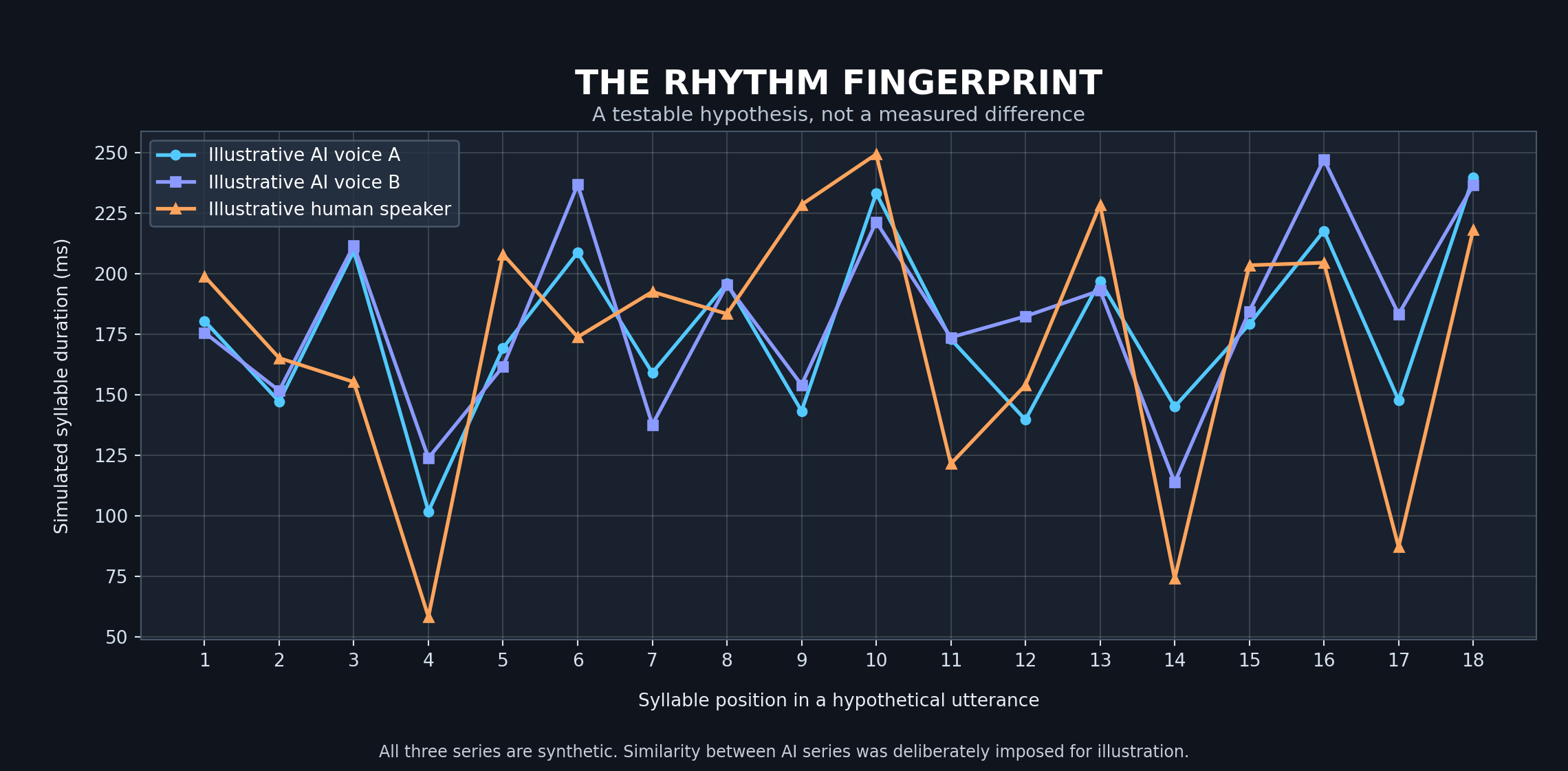
That sketch poses a question we’d need more material to answer. Would several takes with different voices repeat the same timing pattern more often than multiple takes of one voice? That takes reliable word or syllable alignment and enough repetitions to separate a habit from a coincidence. Our two recordings support a quieter claim. On this read, one leaves more space than the other.
Is predictability the problem?
The interesting kind of variety depends on context. “You made it” could be relief, surprise or praise. A system that produces three wildly different pitch patterns has achieved variety on paper. If none makes sense for the scene, the result is just an inconsistent actor.
Yang and colleagues’ ProsodyEval compares repeated speech outputs across seven text to speech systems and evaluates how acoustic metrics track human ratings of variation. Their results point to a measurement problem. Conventional indicators capture parts of delivery, and the authors’ proposed metric correlated better with ratings on their benchmark. There’s room between “measurably different” and “sounds appropriately different”. Read the ProsodyEval paper.
Speech content also complicates the judgement. Research from the Max Planck Institute for Empirical Aesthetics found that how human a voice sounds can depend on what it says and whether listeners understand the language. That’s a result about perceived humanness. It gives me a reason to treat context seriously, while leaving my hunch about social media exposure open. Read the institute’s study summary.
What a spectrogram can actually tell you
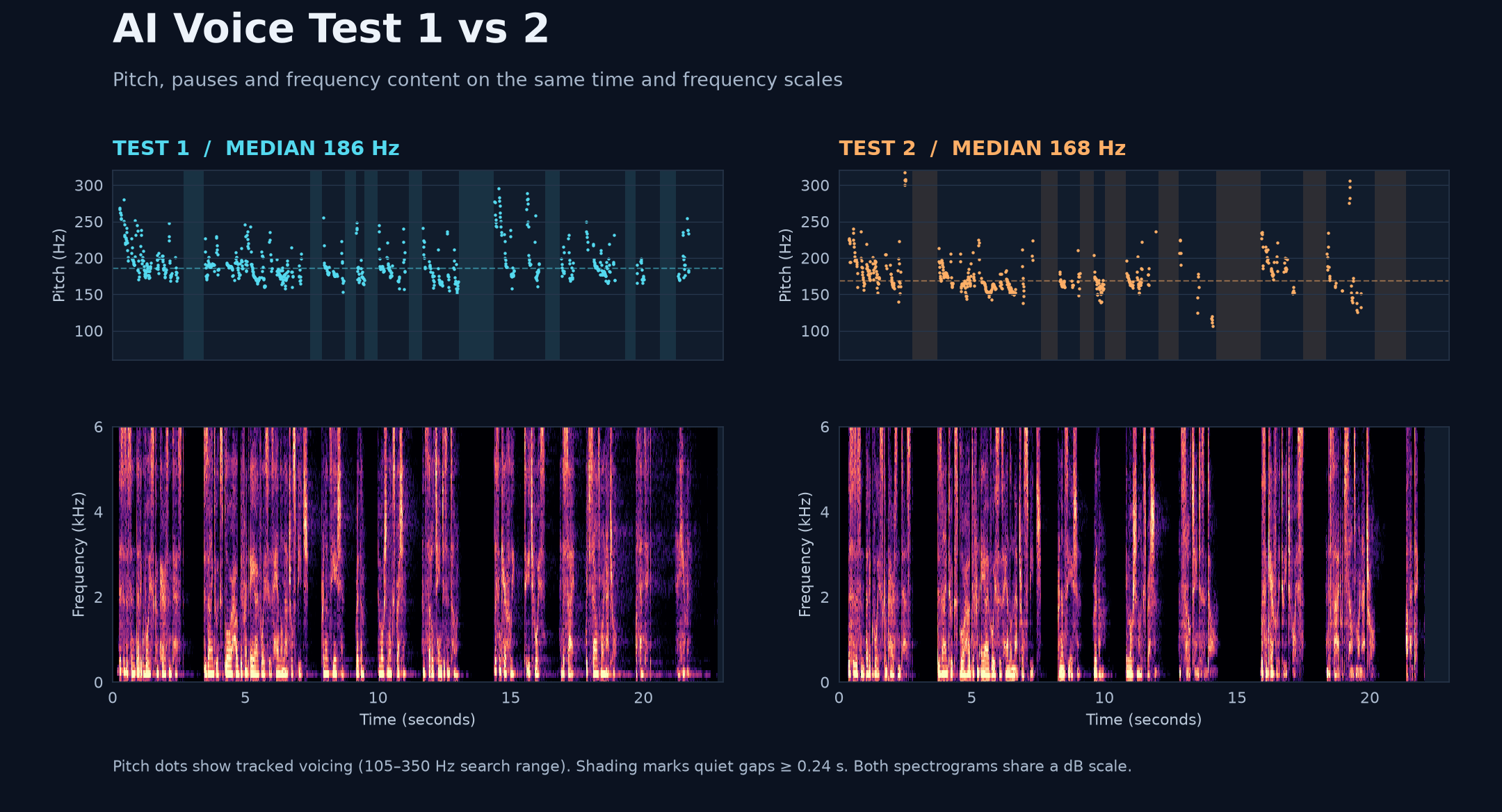
A spectrogram lays out time across the page and frequency up the side. Brighter areas mark stronger signal energy on the same colour scale for both clips. Look for the quieter stretches between blocks of sound. The pitch plots above them track just one feature of those blocks and leave gaps where the tracker found no reliable periodic pitch.
An audio file can tell us that a pause was longer or that more energy fell into a particular frequency range. It can’t tell us whether the speaker sounded sincere, whether the listener had heard that style a hundred times, or whether a particular vocal identity was carried over intact. Even a clean looking graph can be a poor witness if you ask it the wrong question.
The same goes for the waveform you see in an editor. Peaks tell you about amplitude. A smooth waveform and a jagged one can both be made in software. Finding a pattern in a finished MP3 is the beginning of a question about its production.
Give the voice a director
Imagine giving a voice engine a short note before it reads. The listener already knows the launch date. The change is the venue. Put the weight there. That instruction does more than asking for “more expressive” speech. It gives the voice something specific to express.
A context aware prosody director could produce a short delivery plan with phrase breaks, the important word and a cue for how the sentence should finish. The renderer would keep the requested voice fixed and use only controls it actually supports. For a system with limited controls, a sensible first pass might adjust only pauses and punctuation. Adding a lot of pitch movement by hand can turn a subtle correction into a theme park announcement.
Some of the plumbing already exists. The Speech Synthesis Markup Language standard describes controls for breaks, emphasis and prosody. Vendors implement subsets and document constraints, so the director would need to know what each selected voice and engine can handle. Read the SSML standard and Google Cloud’s implementation notes.
There are also architectural routes. FastSpeech 2 conditions synthesis on duration, pitch and energy. F5-TTS uses a different design, based on flow matching, to generate speech. So a practical implementation depends on the engine. Getting better at specifying a performance is a different job from getting better at producing a waveform. FastSpeech 2 paper and F5-TTS paper.
I’d start with a tiny engineering trial. Give the same preset the same sentence in two contexts. Compare an untouched render with a directed one in each context. Check that the intended stress or pause moved, the words survived, the pitch stayed within a sensible range and the extra processing time was worth it. A second round could turn individual controls off to see which ones actually did the work. That would show whether the director can follow instructions. Whether people prefer the result is a separate study.
What would change my mind?
For the shared delivery idea, I’d want repeated renders across voices and systems, with the same script and processing. If timing varies just as much within one preset as between presets, a supposed fingerprint from two takes has little value. If several systems repeatedly stress the same words, I’d then want to change the script and see whether the resemblance follows the wording or stays with the voices.
“I can tell it's AI straight away.”
A follow-up could expose one group to a recurring stock voice and another to several voices reading in the same style. Then give both groups fresh clips that vary the preset and delivery independently. Ask two separate questions. “Is this the same voice?” and “Does this sound like the same kind of narration?” More false matches on the first question would support the idea that familiarity spills over to other presets. More correct matches would support voice learning. We didn’t run that study.
Conclusion
I started out wanting to show that the voices were different. Then I listened to the comparison and heard why someone might put them in the same bucket. Both impressions fit what we have. The presets were different, the recordings have measurable differences, and they still sound alike to me when they read the same words. In the original videos, I was also hearing the music and the mood of each piece.
That matters for anyone making narration. The next time a take sounds like something you’ve scrolled past a hundred times, try directing the line before changing the voice. Where does the thought turn? Which word carries the news? What deserves a moment of silence? Sometimes the most interesting setting in a voice generator is the instruction you give the voice.
How we measured the recordings
Pitch was estimated on mono audio sampled at 16 kHz with Praat autocorrelation, a 10 ms step and a search range of 105 to 350 Hz. Quiet gaps were detected on the source audio below −39 dBFS for at least 0.24 seconds, excluding leading and trailing silence. Upper frequency energy is the share from 2 to 7 kHz in voiced frames, using a 16 ms Hann window. The same settings were applied to both clips.
The analysis uses one supplied MP3 per preset. Original engine settings, seeds and mastering details were unavailable for independent inspection. No new voice clips or listener results are included.