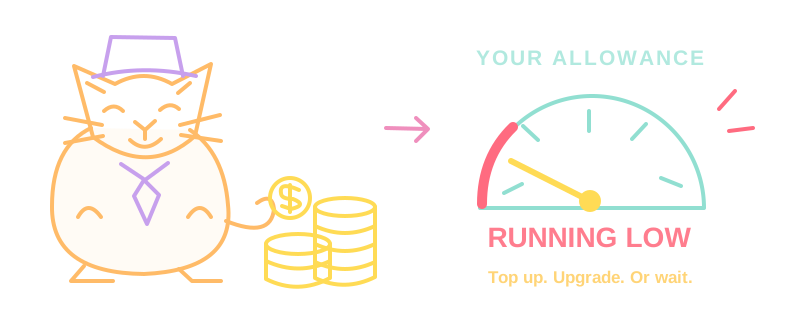
The assistant can build your website, organise your project and carry an idea through to completion. Wonderful. Can it also tell you whether you can afford to let it finish?
That is the question I had after reading OpenAI’s latest email about combining Chat and Work. The smoother workspace sounds useful. The shared allowance sounds like the part subscribers should read twice.
My concern is the familiar subscription squeeze: encourage people to depend on a service, then make continuing their work an increasingly attractive reason to pay more. That is my interpretation of the incentive, not proof of OpenAI’s internal intent.
A tidier desk, a shared meter
OpenAI’s public announcement, checked on 1 November 2026, says Plus, Pro and Business will share a ChatGPT and Codex allowance starting in December. Usage will be measured in tokens and vary with model and task. Instant chat is excluded.
The company expects most users will not have to wait for resets more often. Combined remaining usage and reset times will appear in Settings → Usage. At the limit, the stated choices include waiting, upgrading or buying credits for eligible features.
That is not an announcement that every conversation becomes metered, or evidence that everyone’s allowance has been cut. It does mean the size and rules of the combined pool matter.

“Coming weeks” meets “December”
The email I received describes a small-group test of the combined Chat and Work experience, with shared ChatGPT and Codex usage arriving “in the coming weeks”. The public page names December.
Those phrases are imprecise rather than conclusively contradictory. A limited test and a later rollout could explain them. Subscribers should not have to solve that riddle themselves.
Neither the email nor that announcement supplies a numerical before-and-after allowance for a comparable workload. One meter could be simpler. Whether it buys the same amount of useful work is the unanswered question.
Publish the dates, identify who is affected first, and show what changes for an existing subscriber. “Most users” is a reassurance. It is not a usable budget.
One short request can start a very long job
OpenAI’s Codex guidance already explains that context, reasoning, tools, model and task complexity affect usage. It also describes existing shared pools for eligible agentic features. This is not the invention of metering from scratch.
A brief instruction can still generate substantial work behind the scenes: reading files, producing code, checking results and revising mistakes. A long task need not be wasteful. But time spent and value delivered are different things.

If an assistant takes three attempts to fix its own error, the customer reasonably wants to know how that affected the allowance. “The model thought very hard” is not an itemised explanation.
I am not arguing that every internal computation should be free. I am arguing that a product sold as a capable worker should make its consumption understandable before the worker disappears for half an hour.
Sell me useful work. Don’t make me guess how much of the meter went into getting there.
An allowance meter is not an invoice. The announcement does not explain the accounting for every tool step or failed attempt, and we have not measured the forthcoming pool. Subscribers need a clearer answer than watching a percentage fall.
The upgrade button has plenty of friends
This criticism should not stop at OpenAI’s front door.
Anthropic documents shared usage across Claude, Claude Code and Claude Desktop, affected by factors including complexity, model and effort. Its usage-credit option lets eligible paid subscribers continue beyond included limits through separately charged consumption pricing.
Google’s Gemini Apps guidance also describes compute-based limits influenced by prompt complexity, features, model and chat length. It offers higher access through paid plans and says limits can change, including for capacity reasons. Its guidance describes waiting for a reset or using an available lighter model when limits are reached.
These are different systems, not interchangeable quotas. The recurring commercial tension is familiar: the more useful the assistant becomes, the more inconvenient stopping becomes. That is an excellent place to position an upgrade button.

We didn’t order the data centre
Running AI costs money. A subscription cannot sensibly promise every model, every task and unlimited infrastructure forever. There is a reasonable business problem here.
There is also a reasonable customer response: I bought a service, not a share of your infrastructure expansion plan.
Subscribers did not set the hardware procurement budget or approve another enormous building. If a company invests aggressively, its customers do not acquire a moral obligation to keep topping up.
A company’s need to fund expansion does not settle whether its subscription offers good value. The relevant test is what customers receive for their money, not how ambitious the next infrastructure announcement sounds.

The better response is efficiency. Choose an appropriate model, reuse work where appropriate and stop unnecessary loops. Charge fairly for demanding work, but make avoiding wasted work part of the product too. We made that case in our sustainable computing analysis.
If the only visible solution to a hungry agent is a bigger subscription, the efficiency problem has been handed to the customer’s wallet.
What a better deal would look like
Before starting a substantial task, show an estimated allowance range and let the user set a stopping point. Explain when the work needs a more expensive model. Ask before exceeding the agreed scope.
Afterward, show what the task consumed and what was completed. Distinguish useful checks from repeated repair work. Give customers a clear way to query consumption that looks wrong.

Publish meaningful comparisons across model choices and typical tasks, with the assumptions attached. A remaining percentage is useful; knowing what it can reasonably accomplish is better.
And when changing an existing subscription, tell people plainly whether their expected workload still fits. They should be able to compare plans without becoming amateur token accountants.
Conclusion: unify the workspace, explain the deal
I want more capable AI, not a return to assistants that merely suggest doing the work. A combined workspace could make that experience better.
But convenience should not become cover for an unclear bargain. A shared allowance is not automatically a price rise. It becomes a worse deal if comparable work no longer fits, or if customers cannot predict the difference until they hit the wall.
Keep improving the assistant. Show us the allowance, the accounting and the exit ramp before asking for another upgrade.
Sources and scope
Official policy pages checked 1 November 2026. This is consumer opinion and reported analysis, not a benchmark of the forthcoming shared allowance. Email wording is attributed to the author’s received notice; the message and account details are not reproduced. Product pages can change, and plan, region and rollout eligibility matter. Illustrations are original satire, not financial evidence. AI tools assist research and drafting; publication requires editorial approval.